Douglas Aircraft Company
C-47 Skytrain
 Steve CarmichaelLast updated April 3, 2026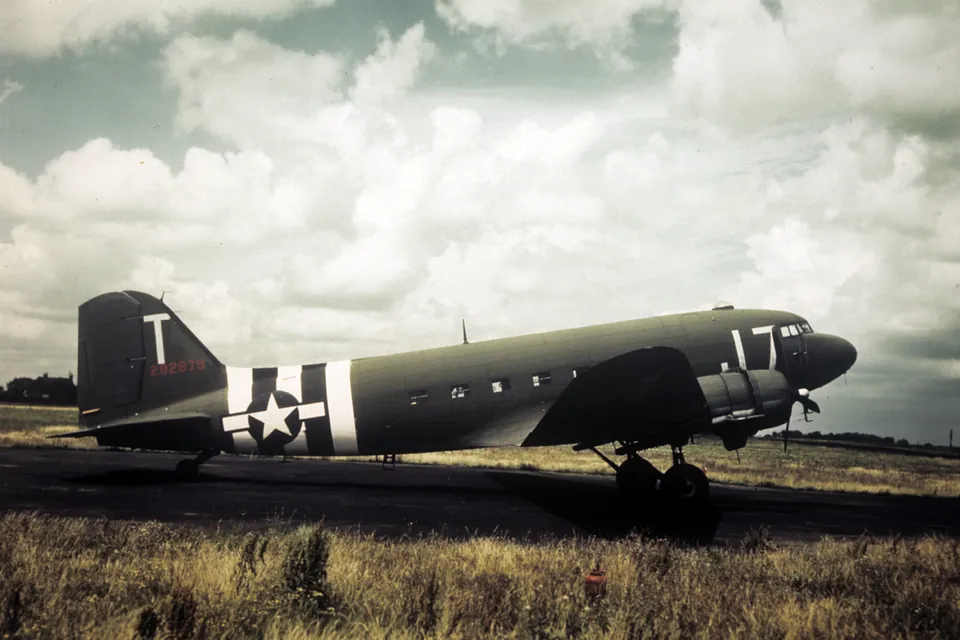
Over 10,000 built for US military use alone, the Douglas C-47 Skytrain — the military version of the legendary DC-3 airliner — was the most important transport aircraft of World War II. General Eisenhower named the C-47 one of the four pieces of equipment most vital to Allied victory, alongside the jeep, the bazooka, and the 2½-ton truck. It dropped paratroopers on D-Day, flew the Hump over the Himalayas, and served on every front in every theater.
C-47 Skytrain at a Glance
- Role
- Transport
- Manufacturer
- Douglas Aircraft Company
- Nation
- United States
- Era
- World War II
By the Numbers
10,000
Built
~10,000+
Built
3–4
Crew
28 per load
Paratroopers
800+
D-Day Aircraft
6,000 lbs
Payload
45+ nations
Operators
Aircraft Description
The Douglas C-47 Skytrain, the military version of the legendary DC-3 airliner, was arguably the most important transport aircraft of World War II. General Eisenhower called it one of the four most important weapons of the war. C-47s dropped paratroopers on D-Day, flew the Hump over the Himalayas to China, and served in every theater. Over 10,000 were built.
From Airliner to Warbird
The C-47 Skytrain began life as the Douglas DC-3, the aircraft that made commercial aviation profitable and transformed the airline industry in the late 1930s. When war came, the Army Air Corps recognized that the DC-3's range, payload, and rough-field capability made it ideal for military transport — but the civilian airliner needed significant modifications. The military C-47 received a reinforced cargo floor rated for heavy equipment, a large port-side cargo door wide enough for a jeep or artillery piece, paratroop static line anchor cables, a glider tow attachment, and deletion of the airline-style passenger amenities. The result was the most versatile transport aircraft of the war.
D-Day: The Night of June 5–6, 1944
The C-47's defining moment came in the predawn hours of D-Day. Over 800 C-47s carried paratroopers of the 82nd and 101st Airborne Divisions across the English Channel and into Normandy. Flying at 500–700 feet through cloud banks and intense German anti-aircraft fire, many aircraft were scattered from their planned drop zones. Paratroopers landed miles from their objectives, in flooded fields, hedgerows, and enemy positions. Despite the chaos — and partly because of it — the dispersed paratroopers disrupted German communications and reinforcement behind the invasion beaches during the critical first hours.
"That's All, Brother" (serial 42-92847) was the lead aircraft of the entire first serial, carrying pathfinders of the 101st Airborne who would mark drop zones for the waves that followed. This aircraft was discovered in a Wisconsin boneyard in 2015, rescued, and restored to airworthy condition through a public fundraising campaign. It returned to Normandy for the 75th anniversary of D-Day in 2019.
Operation Market Garden
On September 17, 1944, the C-47 participated in the largest airborne operation in history. 1,544 C-47s and transports carried three entire airborne divisions — the US 82nd and 101st and the British 1st — into the Netherlands to seize a corridor of bridges leading to the Rhine. The daylight drops were far more accurate than the night drops at Normandy, and the airborne landings themselves were largely successful. The ultimate failure at Arnhem — where the British 1st Airborne was destroyed holding "a bridge too far" — was a ground force problem, not an air transport failure.
The Hump: The Most Dangerous Route
While Europe gets the headlines, the C-47's most punishing service was the India-China "Hump" route — a 500-mile air corridor over the Himalayas that was the only supply line to China after the Japanese cut the Burma Road. C-47Bs with supercharged engines flew at 16,000–20,000 feet through severe turbulence, icing, and unpredictable mountain weather. The wreckage of crashed aircraft was so numerous along the route that pilots navigated by following the "aluminum trail" of debris on the mountainsides. Over 1,000 aircraft and their crews were lost on the Hump during the war.
Eisenhower's "Four Most Important Weapons"
After the war, General Dwight D. Eisenhower was asked to name the four pieces of equipment most vital to Allied victory. His answer: the bulldozer, the jeep, the 2½-ton truck, and the C-47. The inclusion of a transport aircraft alongside the most basic ground equipment speaks to how completely the C-47 had integrated itself into Allied military operations. It dropped paratroopers, towed gliders, hauled cargo, evacuated wounded, delivered fuel, carried VIPs, and — in one famous incident — was used by General Patton for personal reconnaissance ahead of his armor columns, flying at 50 feet to observe road traffic.
Paint Schemes and Markings
The C-47 Skytrain is perhaps best known for the bold black-and-white invasion stripes it wore during Operation Overlord — markings that have become synonymous with D-Day itself.
- Olive Drab over Neutral Gray (1942–1944): Standard USAAF scheme — Dark Olive Drab (ANA 613) uppers over Neutral Gray (ANA 603) undersides. The most common scheme for Troop Carrier Command aircraft through 1944. "That's All, Brother" — the lead C-47 for D-Day — wore this scheme.
- D-Day Invasion Stripes (June 1944): Five alternating black and white stripes, each 18 inches wide, applied around both wings and the rear fuselage. Over 800 C-47s and RAF Dakotas carried these stripes. Applied hastily in the days before June 6, 1944, often with house paint and mops. The stripes were critical for preventing friendly fire from anti-aircraft gunners. One of the most visually striking and model-friendly markings of WWII.
- Natural Metal Finish (1944–1945): Late-production C-47B models delivered unpainted. Used primarily in CBI and Pacific theaters where camouflage was less critical for transport operations.
- Paratroop and Glider Tug Markings: Troop Carrier Groups used two-letter squadron codes on fuselage sides. Pathfinder aircraft carried special recognition markings. Red crosses on white squares for medical evacuation missions (Geneva Convention markings).
Design Features
Key engineering and design choices that defined the C-47 Skytrain's capabilities.
Reinforced Cargo Floor and Large Loading Door
The C-47's cargo floor was strengthened well beyond the civilian DC-3 standard, rated for heavy military equipment including artillery pieces, jeep components, and medical litters. The large port-side aft cargo door — wider than the DC-3 passenger door — enabled rapid loading and unloading of bulky military equipment that could never fit through a standard airliner door. This modification was the single most important difference between the civilian DC-3 and the military C-47.
Glider Tow Attachment
A dedicated tow cleat and reinforced tail cone enabled the C-47 to tow Waco CG-4A and Airspeed Horsa assault gliders — each carrying up to 15 troops or a jeep with crew. This capability was used extensively at Sicily (Operation Husky), D-Day (Operation Overlord), Market Garden, and the Rhine crossing (Operation Varsity). The tow system allowed a single C-47 to deliver both a paratroop stick from its cabin and a glider full of troops or equipment on the same mission.
Paratroop Static Line Anchor Cables
Steel cables running the length of the cabin interior allowed mass paratroop drops. Each paratrooper clipped his static line to the cable, and as he jumped, the line automatically deployed his parachute. A jumpmaster station at the door controlled timing and spacing. The C-47 could carry 28 fully equipped paratroopers — the standard 'stick' — and deliver them in under 30 seconds at speeds of 90–110 mph.
Short-Field and Rough-Strip Capability
The C-47's wide-track main landing gear and robust oleo-pneumatic struts were designed for operations from improvised strips that would destroy lesser aircraft. C-47s routinely operated from pierced-steel planking (Marston Mat), dirt strips, grass fields, and even beach landing zones in the Pacific. This rough-field capability was essential for delivering supplies to forward combat units operating far from established airfields.
C-47B High-Altitude Modification
The C-47B variant was specifically engineered for the Hump route — the India-to-China air supply corridor over the Himalayas, one of the most dangerous flying routes in aviation history. Supercharged R-1830-90D engines maintained power at altitudes of 16,000–20,000 ft, and increased fuel capacity extended the 500-mile route over terrain where forced landings were impossible. Over 1,000 aircraft and their crews were lost on the Hump route during the war.
Engines & Armament
Powerplant and weapons configuration for the C-47 Skytrain's primary production variant.
Powerplant
2x Pratt & Whitney R-1830-90C Twin Wasp, 14-cylinder twin-row air-cooled radial, 1,200 hp each. The C-47B introduced supercharged R-1830-90 or -90D engines for high-altitude operations over the Himalayas (the "Hump" route). Normal cruise was 175 mph (282 km/h) at 10,000 ft.
Armament
Unarmed. No defensive armament was fitted to standard C-47 variants. The aircraft was a pure transport — its "weapons" were the paratroopers, cargo, and supplies it delivered. Note: the postwar AC-47 "Spooky" gunship conversion fitted three 7.62 mm miniguns for Vietnam-era operations, but this is outside WWII scope.
Specifications
Key dimensions and performance figures for the C-47 Skytrain's primary production variant.
- Crew
- 4
- Length
- 19.43 m(63.7 ft)
- Wingspan
- 29.11 m(95.5 ft)
- Height
- 5.18 m(17.0 ft)
- Wing Area
- 91.7 m²(987 ft²)
- Max Speed
- 360 km/h(224 mph)
Variants & Models
Each C-47 Skytrain variant introduced changes to the airframe, engine, or armament. Visual ID features help modelers and spotters distinguish between versions.
C-47
965
Built
- Powerplant
- 2x P&W R-1830-92, 1,200 hp each
- Max Speed
- 360 km/h(224 mph)
- Range
- 2,575 km(1,600 mi)
- Ceiling
- 7,315 m(23,999 ft)
Visual ID
Initial military production; 24-volt electrical system
Initial military transport variant. 24-volt electrical system distinguished from later C-47A. 965 built.
C-47ASkytrain
5,254
Built
- Powerplant
- 2x P&W R-1830-92, 1,200 hp each
- Max Speed
- 360 km/h(224 mph)
- Range
- 2,575 km(1,600 mi)
- Ceiling
- 7,315 m(23,999 ft)
Visual ID
Most common variant; 12-volt single-phase electrical system
The most numerous C-47 variant with a simplified 12-volt electrical system. 5,254 built. The majority of D-Day and European theater C-47s were this model.
C-47BSkytrain
3,241
Built
- Powerplant
- 2x P&W R-1830-90D, 1,200 hp (supercharged)
- Max Speed
- 360 km/h(224 mph)
- Range
- 2,575 km(1,600 mi)
- Ceiling
- 8,045 m(26,394 ft)
Visual ID
Supercharged engines for high-altitude Hump operations; increased fuel capacity
High-altitude variant with supercharged engines for the India-China "Hump" route over the Himalayas. Increased fuel capacity for the 500-mile route. 3,241 built.
C-53Skytrooper
380
Built
- Powerplant
- 2x P&W R-1830-92, 1,200 hp each
- Max Speed
- 360 km/h(224 mph)
- Range
- 2,575 km(1,600 mi)
- Ceiling
- 7,315 m(23,999 ft)
Visual ID
No cargo door or cargo hoist; airline-style passenger seats only
Troop-only variant without the C-47's large cargo door or cargo handling equipment. Standard airline-type passenger seats for 28 troops. 380 built.
R4D
- Powerplant
- 2x P&W R-1830-92, 1,200 hp each
- Max Speed
- 360 km/h(224 mph)
- Range
- 2,575 km(1,600 mi)
- Ceiling
- 7,315 m(23,999 ft)
Visual ID
US Navy/Marine Corps designation; identical to USAAF C-47 variants
The US Navy and Marine Corps designation for C-47 variants. R4D-1 corresponded to the C-47, R4D-5 to the C-47A, R4D-6 to the C-47B. Served throughout the Pacific with naval transport and Marine units.
Dakota
- Powerplant
- 2x P&W R-1830-92, 1,200 hp each
- Max Speed
- 360 km/h(224 mph)
- Range
- 2,575 km(1,600 mi)
- Ceiling
- 7,315 m(23,999 ft)
Visual ID
RAF/Commonwealth designation; Dakota Mk I–IV corresponding to C-47 variants
The RAF and Commonwealth designation. Dakota Mk I corresponded to the C-47, Mk III to the C-47A, Mk IV to the C-47B. Served with RAF Transport Command, the RCAF, RAAF, and RNZAF.
Development & Operational Timeline
Key milestones in the C-47 Skytrain's journey from design through operational service.
DC-3 Enters Commercial Service
The Douglas DC-3 airliner enters commercial service, revolutionizing civil aviation with its range, passenger comfort, and reliability. The DC-3 will become the basis for the military C-47.
US Army Orders Military DC-3 Variant
The US Army Air Corps orders a militarized version of the DC-3 with reinforced cargo floor, large cargo door, and paratroop equipment. The resulting C-47 Skytrain will become the most important transport aircraft of the war.
First C-47 Delivered
The first production C-47 Skytrain is delivered to the US Army Air Forces. Mass production ramps up rapidly at Douglas factories in Long Beach, California, and Oklahoma City, Oklahoma.
Hump Operations — India to China
C-47s (primarily C-47B) fly the India-China air route over the Himalayas, the most demanding sustained airlift of the war. Over 1,000 aircraft are lost on the treacherous 500-mile route over 16,000–20,000 ft terrain, delivering fuel, ammunition, and supplies to sustain Chinese forces and B-29 operations.
Operation Torch — North Africa
C-47s participate in the first major Allied airborne operation, dropping paratroopers in North Africa during Operation Torch. The experience reveals critical lessons in night navigation and coordination.
Operation Husky — Sicily
226 C-47s carry 82nd Airborne Division paratroopers in the first large-scale Allied airborne operation. Severe friendly fire from Navy anti-aircraft guns causes significant transport losses. The disaster leads to improved coordination procedures used at Normandy.
D-Day — Operation Overlord
Over 800 C-47s carry paratroopers of the 82nd and 101st Airborne Divisions into Normandy in the predawn hours of D-Day. Night drops in cloud and fog scatter units widely but achieve strategic disruption behind the invasion beaches. "That's All, Brother" (42-92847) leads the first wave.
Operation Market Garden
1,544 C-47s and transport aircraft carry three airborne divisions — the US 82nd and 101st and the British 1st — into the Netherlands in the largest airborne operation in history. Despite the ultimate failure to hold the bridge at Arnhem, the airlift itself is a remarkable logistical achievement.
Berlin Airlift
C-47s are among the first aircraft used in the Berlin Airlift (Operation Vittles), supplying West Berlin during the Soviet blockade. The C-47's limited cargo capacity leads to replacement by the larger C-54 Skymaster, but the type's role in the early weeks is critical.
Combat History
Major engagements and missions that defined the C-47 Skytrain's combat record.
Hump Operations — India to China
1942–1945C-47s and C-47Bs flew the India-China air route over the Himalayas — the "Hump" — the most demanding sustained airlift of WWII. The 500-mile route over 16,000–20,000 ft mountain passes, through severe turbulence, icing, and unpredictable weather, claimed over 1,000 aircraft and their crews during the war. The airlift sustained Chinese Nationalist forces and supplied the B-29 bases in China.
The Hump operations were the most dangerous sustained flying operation of the war. The C-47B, with its supercharged engines for high-altitude performance, was specifically developed for this route. The experience gained on the Hump directly influenced the planning and execution of the Berlin Airlift three years later.
Operation Torch / Tunisia
1942–1943C-47s conducted the first major combat use of US airborne forces, dropping paratroopers in North Africa during Operation Torch. The 39th Troop Carrier Squadron and other units gained early lessons in low-level night navigation for mass drops that would prove invaluable for later operations.
Established the foundation for all subsequent Allied airborne operations. The navigation and coordination problems encountered over North Africa drove procedural improvements that reduced — though never eliminated — the chaos of large-scale night airborne assaults.
Operation Husky — Sicily
July 9–10, 1943226 C-47s carried 82nd Airborne Division paratroopers into Sicily in the first large-scale Allied airborne operation. The drop was badly scattered by high winds and navigation errors. Worse, on the second night, returning C-47s flew over the Allied invasion fleet and were fired upon by nervous Navy anti-aircraft gunners — 23 aircraft were shot down and 37 damaged by friendly fire.
226
Dispatched
23
Aircraft Lost
The Sicily friendly fire disaster — where Navy AA guns shot down more C-47s than the enemy — led directly to the improved identification and coordination procedures used at Normandy. The hard lessons of Husky saved lives on D-Day.
D-Day — Operation Overlord
June 5–6, 1944Over 800 C-47s carried paratroopers of the 82nd and 101st Airborne Divisions into Normandy in the predawn hours of June 6, 1944. Flying at 500–700 ft through cloud banks and German anti-aircraft fire, many aircraft were scattered from their planned drop zones. Despite wide dispersal, the paratroopers achieved strategic disruption behind the invasion beaches. "That's All, Brother" (42-92847) was the lead aircraft of the first serial.
822
Dispatched
The largest and most consequential airborne operation of the war. The C-47 made D-Day possible — without air transport, the 82nd and 101st could not have been inserted behind the beaches to disrupt German reinforcement. The operation proved that massed airborne assault, despite inevitable chaos, could decisively shape a ground campaign.
Operation Market Garden
September 17–25, 1944In the largest airborne operation in history, 1,544 C-47s and transports carried three airborne divisions — the US 82nd Airborne, US 101st Airborne, and British 1st Airborne — into the Netherlands to seize bridges across the Rhine. The airborne landings themselves were largely successful, but the ground force advance was too slow to reach the British paratroopers at Arnhem.
1,544
Dispatched
Despite the strategic failure at Arnhem, the airlift itself demonstrated that Allied air transport could deliver an entire corps by air in a single day — an organizational and logistical achievement without precedent.
Unit Markings
The C-47 Skytrain served with units whose markings are documented in our markings reference guides.
Production & Service
From first flight to retirement — the C-47 Skytrain's operational lifespan at a glance.
- Number Built
- 10,000
- First Service
- 1941
- Last Built
- 1945
- Status
- Retired
Where to See One
Surviving C-47 Skytrain aircraft you can visit today. Airworthy aircraft may appear at air shows.
"That's All, Brother" (42-92847)
S/N: 42-92847
Variant: C-47A
The lead C-47 for the D-Day airborne operations on June 6, 1944. Rescued from an aircraft boneyard, restored to airworthy condition in 2018 through a public fundraising campaign. Participates in D-Day anniversary events in Normandy. The most historically significant surviving C-47.
"Tico Belle" (42-100591)
S/N: 42-100591
Variant: C-47A
Airworthy C-47A at the Valiant Air Command Warbird Museum.
"What's Up Doc?"
Variant: C-47
Airworthy C-47 at the Palm Springs Air Museum. Warbird rides available.
"Whiskey 7" (43-30652)
S/N: 43-30652
Variant: C-47A
Flew lead of the second wave D-Day drop with 82nd Airborne. Airworthy. Returned to Normandy for the 70th anniversary drop in 2014.
Dakota III ZA947 (RAF BBMF)
S/N: ZA947
Variant: Dakota III
The BBMF Dakota — airworthy C-47A/Dakota III operated by the RAF Battle of Britain Memorial Flight. Regular UK airshow appearances.
"Turf & Sport Special"
Variant: C-47A
Displayed in D-Day invasion stripes. Documented D-Day combat history with 61st TCS/82nd Airborne. Static display at the Air Mobility Command Museum.
C-47B / R4D-6 (Museum of Aviation)
Variant: C-47B
C-47B (Navy R4D-6 designation) on static display at the Museum of Aviation.
C-47D (USAF Museum)
Variant: C-47D
C-47D on static display at the National Museum of the US Air Force.
Dakota IV KN645
S/N: KN645
Variant: Dakota IV
Dakota IV on static display at the RAF Museum Cosford.
Written by
Steve Carmichael
I am a ww2 model enthusiast getting back into building scaled models after many years away. This site allows me to work on my web development skills while sharing what I am learning.