Douglas Aircraft Company
SBD Dauntless
 Steve CarmichaelLast updated April 3, 2026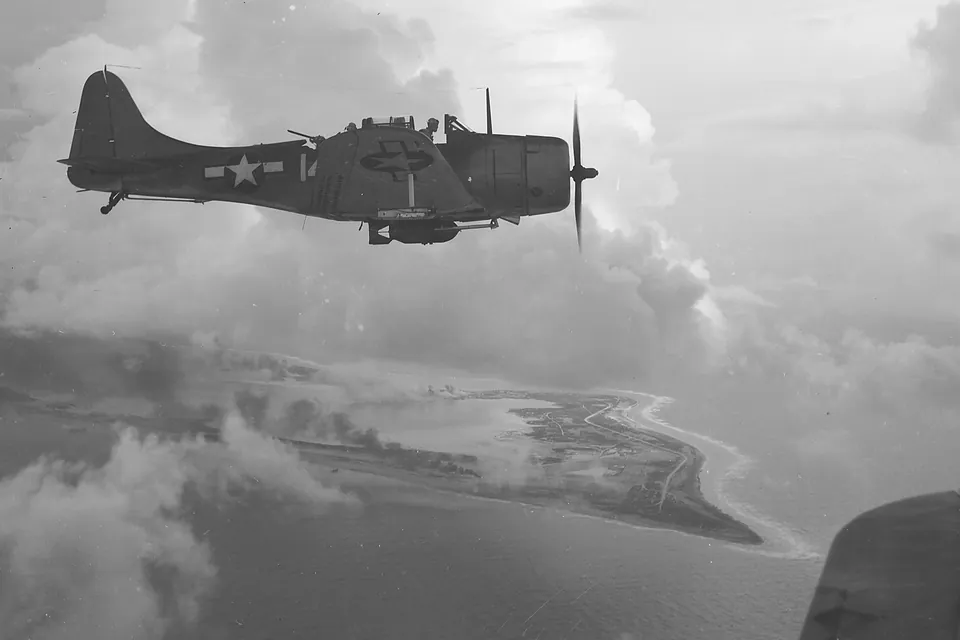
The Douglas SBD Dauntless was the most important American dive bomber of World War II, with 5,936 built between 1940 and 1944. At the Battle of Midway on June 4, 1942, SBD-3 Dauntless dive bombers from USS Enterprise and USS Yorktown sank four Japanese fleet carriers in roughly five minutes — the most decisive naval air attack in history. Called "Slow But Deadly" by its crews, the SBD sank more Japanese shipping tonnage than any other Allied aircraft and remained in frontline service until replaced by the SB2C Helldiver in late 1944.
SBD Dauntless at a Glance
- Role
- Dive Bomber
- Manufacturer
- Douglas Aircraft Company
- Nation
- United States
- Era
- World War II
By the Numbers
5,936
Built
Sank 4 carriers at Midway in ~5 minutes
Most Decisive Strike
Sank more Japanese shipping than any other Allied aircraft
Tonnage Record
"Slow But Deadly" — SBD initials
Crew Nickname
Ed Heinemann — Douglas Aircraft
Designer
70-degree near-vertical attack dives
Dive Angle
Every major Pacific carrier battle 1942–1944
Service Record
Aircraft Description
The Douglas SBD Dauntless was the most important American dive bomber of the early Pacific War. At the Battle of Midway, Dauntless dive bombers sank four Japanese fleet carriers in minutes, turning the tide of the Pacific War. Despite being called "Slow But Deadly" by its crews, the SBD had an outstanding combat record and sank more Japanese shipping than any other aircraft.
SBD Dauntless History
Origins: From Northrop to Douglas
The SBD Dauntless traced its lineage to the Northrop BT-1 dive bomber of the late 1930s. When Douglas Aircraft absorbed the Northrop Corporation in 1937, chief engineer Ed Heinemann took over the BT-1 design and substantially redesigned it. The result — originally designated XBT-2 before being redesignated XSBD-1 — featured a more powerful Wright Cyclone engine, completely redesigned tail surfaces, the signature perforated split dive flaps, and numerous structural improvements. The SBD first flew in 1939 and entered service with Marine squadrons in late 1940.
The Weapon That Won Midway
The SBD Dauntless's place in history was secured on the morning of June 4, 1942, at the Battle of Midway. After hours of failed attacks by torpedo bombers — including the near-total destruction of VT-8's TBD Devastators — SBD-3 dive bombers from USS Enterprise and USS Yorktown arrived over the Japanese carrier striking force at the critical moment. The Japanese combat air patrol had been drawn down to sea level by the torpedo bomber attacks, leaving the carriers virtually undefended against attack from above.
In approximately five minutes of dive bombing, VB-6 and VS-6 from Enterprise fatally hit Kaga and Akagi, while VB-3 from Yorktown struck Soryu. All three carriers were caught with armed and fueled aircraft on their flight decks, and the bomb hits ignited catastrophic fires that consumed all three ships. The fourth carrier, Hiryu, was sunk by a follow-up Enterprise strike that afternoon. The loss of four fleet carriers and their experienced air groups was a blow from which the Imperial Japanese Navy never recovered.
The Solomons Campaign
After Midway, the SBD proved itself again during the grueling Guadalcanal campaign from August 1942 to February 1943. Marine dive bomber squadrons operating from Henderson Field — the crude airstrip that was the prize of the campaign — flew in some of the most intense conditions of the Pacific War. During the Naval Battle of Guadalcanal in November 1942, SBDs scored hits on the battleship Hiei, contributing to her sinking. Marine and Navy Dauntless pilots attacked Japanese transports, cruisers, and destroyers throughout the campaign, repeatedly disrupting Japanese attempts to reinforce the island.
SBDs also fought in the carrier battles of the Eastern Solomons and Santa Cruz, sinking the light carrier Ryujo and damaging the fleet carriers Shokaku and Zuiho. These battles gradually attrited Japan's irreplaceable pool of experienced carrier pilots.
"Slow But Deadly"
The SBD earned its famous nickname from crews who noted that its initials conveniently spelled out "Slow But Deadly." With a maximum speed of only 410 km/h, the Dauntless was indeed slow compared to contemporary fighters — and even some bombers. But speed was secondary to the SBD's real strengths: superb dive bombing accuracy (the perforated flaps allowed remarkably stable 70-degree dives), rugged construction that could absorb battle damage, and excellent handling qualities that made it popular with pilots. Many aviators actually preferred the SBD to its faster replacement, the SB2C Helldiver, which earned the less flattering nickname "Son of a Bitch 2nd Class."
Legacy
By the time production ended in July 1944 with 5,936 aircraft delivered, the SBD Dauntless had compiled a combat record unmatched by any other dive bomber in history. It had sunk more Japanese shipping tonnage than any other Allied aircraft — including six carriers, fourteen cruisers, and numerous destroyers and transports. The Dauntless fought in every major Pacific carrier battle from Coral Sea to the Philippine Sea, and its victory at Midway remains the single most decisive naval air action ever fought.
Paint Schemes and Markings
The SBD Dauntless wore a variety of paint schemes across its service life, reflecting the rapid evolution of US Navy camouflage doctrine during the early years of the Pacific War. From the colorful prewar markings to austere combat camouflage, Dauntless paint schemes tell the story of a Navy learning to fight a modern air-sea war.
Light Gray over Light Gray (Pre-War, 1940–1941)
Early SBD-1 and SBD-2 models wore the prewar US Navy scheme of overall Light Gray (ANA 602) — a uniform light gray covering all surfaces. This scheme was standard for carrier aircraft before the war and featured colorful unit markings including brightly painted engine cowlings, fuselage bands, and tail chevrons. National insignia consisted of a star-and-circle on the fuselage sides and wings, with a red-and-white-striped rudder.
Blue-Gray over Light Gray (1941–1943)
After Pearl Harbor, SBDs transitioned to the two-tone scheme of Blue-Gray (ANA 603) upper surfaces over Light Gray (ANA 602) undersides. The colorful prewar unit markings were toned down, and the red center dot was removed from the national insignia in May 1942 to prevent confusion with the Japanese hinomaru. This is the scheme worn by SBD-3s at the battles of Coral Sea and Midway — the most historically significant Dauntless markings.
Tri-Color Scheme (1943–1944)
Beginning in 1943, SBDs adopted the tri-color camouflage of Sea Blue (ANA 607) upper surfaces, Intermediate Blue (ANA 608) on vertical surfaces, and Insignia White (ANA 601) on undersides. This scheme provided better concealment when viewed from above against the dark ocean and from below against the sky. The national insignia gained its distinctive white bars and blue surround in June 1943.
Overall Glossy Sea Blue (1944)
Late-war SBD-5 and SBD-6 models wore the simplified Glossy Sea Blue (ANA 623) overall scheme adopted by the Navy in 1944. By this point, American air superiority was well established and the need for elaborate camouflage had diminished. White national insignia and minimal markings gave these late Dauntless aircraft a stark, businesslike appearance.
Marine Corps Field Schemes
Marine SBDs operating from Henderson Field on Guadalcanal and other Pacific island bases often displayed hastily applied and heavily weathered paint, with field-applied touch-ups in whatever colors were available. The brutal tropical conditions — heat, humidity, coral dust, and salt spray — rapidly deteriorated paint finishes, giving Marine Dauntless aircraft a distinctively worn appearance quite different from their carrier-based Navy counterparts.
Design Features
Key engineering and design choices that defined the SBD Dauntless's capabilities.
Perforated Split Dive Flaps
The SBD's most distinctive feature was its large perforated (Swiss-cheese) split trailing-edge dive flaps. When deployed, the holes allowed air to pass through, stabilizing the aircraft during steep 70-degree dives and preventing dangerous buffeting. These flaps gave pilots precise control at terminal velocity, allowing them to hold the target in their sights far longer than conventional dive bombers. The perforated design was patented by designer Ed Heinemann and became a hallmark of the Dauntless.
Bomb Displacement Trapeze
A swinging trapeze mechanism mounted under the fuselage swung the bomb down and clear of the propeller arc before release during a steep dive. Without this device, a bomb dropped in a near-vertical dive would strike the propeller. The trapeze was a simple but essential piece of engineering that made accurate dive bombing possible and was visible as a distinctive fork-shaped cradle under the fuselage when the aircraft was on the ground.
Rugged Low-Wing Construction
The SBD featured a multi-spar stressed-skin wing and a robust fuselage designed to withstand the extreme G-forces of dive bombing — typically 6G or more during pullout from a steep dive. The wings incorporated self-sealing fuel tanks from the SBD-3 onward, and the fuselage was reinforced around the cockpit area. This structural strength meant the Dauntless could take considerable battle damage and still fly home, earning it a reputation for toughness that belied its modest performance numbers.
Excellent Cockpit Visibility
The SBD's cockpit was positioned well forward with a relatively low cowling, giving the pilot outstanding forward and downward visibility — critical for identifying and tracking targets during a dive bombing attack. The greenhouse-style rear canopy gave the gunner excellent rearward visibility for defense. This all-around visibility also made the SBD effective in the scouting role, where detecting enemy ships first could determine the outcome of a battle.
Two-Man Crew with Rear Gunner
The Dauntless carried a pilot and a rear-seat radioman/gunner who operated the flexible .30 caliber machine gun(s) for defense against attacking fighters. The gunner also handled radio communication and navigation duties. This two-man arrangement proved vital: rear gunners claimed numerous Japanese fighters, and their ability to report position and enemy contacts during scouting missions was essential to fleet operations. The teamwork between pilot and gunner was central to the SBD's combat effectiveness.
Engines & Armament
Powerplant and weapons configuration for the SBD Dauntless's primary production variant.
Powerplant
1x Wright R-1820 Cyclone, 9-cylinder single-row air-cooled radial engine. The SBD-1 through SBD-4 used the R-1820-32 or R-1820-52 rated at 1,000 hp, while the SBD-5 introduced the R-1820-60 at 1,200 hp. The final SBD-6 used the R-1820-66 producing 1,350 hp. All variants drove a three-blade Hamilton Standard constant-speed propeller.
Armament
Two .50 caliber M2 Browning machine guns fixed forward in the engine cowling, firing through the propeller arc via synchronizer gear. One or two .30 caliber flexible-mount machine guns in the rear cockpit operated by the gunner (single gun on SBD-1/2, twin guns from SBD-3 onward). Centerline bomb displacement gear (swinging trapeze) carried one 1,000 lb or 500 lb bomb; underwing racks for two additional 100 lb or 250 lb bombs, for a maximum load of 1,200 lbs.
Specifications
Key dimensions and performance figures for the SBD Dauntless's primary production variant.
- Crew
- 2
- Length
- 10.09 m(33.1 ft)
- Wingspan
- 12.66 m(41.5 ft)
- Height
- 4.14 m(13.6 ft)
- Wing Area
- 30.2 m²(325 ft²)
- Max Speed
- 410 km/h(255 mph)
Variants & Models
Each SBD Dauntless variant introduced changes to the airframe, engine, or armament. Visual ID features help modelers and spotters distinguish between versions.
SBD-1Dauntless
57
Built
- Powerplant
- 1× Wright R-1820-32 Cyclone (1,000 hp)
- Max Speed
- 402 km/h(250 mph)
- Range
- 1,770 km(1,100 mi)
- Ceiling
- 8,260 m(27,100 ft)
Visual ID
Short exhaust stubs; no self-sealing fuel tanks; Marine Corps only — earliest production airframes.
Initial Marine Corps production variant; first deliveries late 1940.
SBD-2Dauntless
87
Built
- Powerplant
- 1× Wright R-1820-32 Cyclone (1,000 hp)
- Max Speed
- 402 km/h(250 mph)
- Range
- 1,770 km(1,100 mi)
- Ceiling
- 8,260 m(27,100 ft)
Visual ID
Larger fuel capacity than SBD-1; early Navy variant — otherwise visually identical to SBD-1.
Navy variant with increased fuel; served at Midway aboard USS Lexington and Yorktown.
SBD-3Dauntless
584
Built
- Powerplant
- 1× Wright R-1820-52 Cyclone (1,000 hp)
- Max Speed
- 410 km/h(255 mph)
- Range
- 1,770 km(1,100 mi)
- Ceiling
- 8,260 m(27,100 ft)
Visual ID
Self-sealing fuel tanks and armor plate behind pilot; twin rear .30 cal guns (key ID vs SBD-1/2 single gun).
The Midway hero — this variant sank four Japanese carriers on 4 June 1942.
SBD-4Dauntless
780
Built
- Powerplant
- 1× Wright R-1820-52 Cyclone (1,000 hp)
- Max Speed
- 410 km/h(255 mph)
- Range
- 1,770 km(1,100 mi)
- Ceiling
- 8,260 m(27,100 ft)
Visual ID
Hamilton Standard hydromatic propeller (24-volt electrical system) replaces earlier pneumatic prop; external appearance very close to SBD-3.
Transitional variant; introduced 24-volt electrical system and Hamilton Standard propeller.
SBD-5Dauntless
2,965
Built
- Powerplant
- 1× Wright R-1820-60 Cyclone (1,200 hp)
- Max Speed
- 410 km/h(255 mph)
- Range
- 1,794 km(1,115 mi)
- Ceiling
- 7,780 m(25,525 ft)
Visual ID
Most-produced variant; upgraded R-1820-60 engine with slightly different cowling contour; reflector gunsight replaces telescopic sight.
Largest production block; served extensively in the Solomons and Central Pacific campaigns.
SBD-6Dauntless
451
Built
- Powerplant
- 1× Wright R-1820-66 Cyclone (1,350 hp)
- Max Speed
- 420 km/h(261 mph)
- Range
- 1,794 km(1,115 mi)
- Ceiling
- 7,780 m(25,525 ft)
Visual ID
Final production Dauntless; most powerful engine variant — subtle cowl flap differences; many served with Marine Corps rather than carrier units.
Last production variant; most went to Marine squadrons as Navy transitioned to SB2C Helldiver.
A-24 BansheeBanshee
168
Built
- Powerplant
- 1× Wright R-1820-52 Cyclone (1,000 hp)
- Max Speed
- 402 km/h(250 mph)
- Range
- 1,770 km(1,100 mi)
- Ceiling
- 8,260 m(27,100 ft)
Visual ID
Army Air Forces variant — no arrestor hook or carrier equipment; pneumatic tail wheel instead of solid; otherwise identical to SBD-3.
USAAF version based on SBD-3; saw action in Java and New Guinea with mixed results in the land-based role.
A-24BBanshee
615
Built
- Powerplant
- 1× Wright R-1820-60 Cyclone (1,200 hp)
- Max Speed
- 410 km/h(255 mph)
- Range
- 1,794 km(1,115 mi)
- Ceiling
- 7,780 m(25,525 ft)
Visual ID
Army equivalent of SBD-5; no arrestor hook; many relegated to training and tow-target duties stateside.
USAAF version based on SBD-5; most served in training roles rather than frontline combat.
Development & Operational Timeline
Key milestones in the SBD Dauntless's journey from design through operational service.
Northrop BT-1 Leads to Douglas SBD
The Douglas Aircraft Company absorbs the Northrop Corporation, and Ed Heinemann begins redesigning the Northrop BT-1 dive bomber into what will become the SBD Dauntless. Key improvements include a more powerful Wright Cyclone engine, redesigned tail surfaces, and the signature perforated dive flaps.
XBT-2 Prototype First Flight
The XBT-2 prototype (redesignated XSBD-1) makes its first flight at El Segundo, California. Testing confirms the effectiveness of the perforated dive flaps and bomb displacement trapeze, and the Navy orders the type into production.
First SBD-1s Delivered to Marines
Marine dive bombing squadrons VMB-2 and VMB-1 receive the first production SBD-1 Dauntless aircraft, making the Marines the first service branch to operate the type.
SBD-2 Enters Navy Service
Navy scouting and bombing squadrons aboard USS Lexington and USS Yorktown begin receiving SBD-2 models with increased fuel capacity. The SBD rapidly replaces the older SBC Curtiss biplanes and BT-1s in fleet service.
Pearl Harbor — SBDs Caught in the Attack
SBDs from USS Enterprise are airborne on a routine scouting mission when the Japanese attack Pearl Harbor. Several Dauntless aircraft arrive over Oahu during or after the attack; some are lost to friendly fire. Marine SBDs at Ewa Field are destroyed on the ground.
Battle of the Coral Sea
SBD-3s from USS Lexington and USS Yorktown participate in the first carrier-versus-carrier battle in history. Dauntless dive bombers score hits on the light carrier Shoho (sinking her) and damage the fleet carrier Shokaku. The battle proves the effectiveness of carrier dive bombing.
Battle of Midway — Four Carriers Sunk
In the most decisive five minutes of the Pacific War, SBD-3 Dauntless dive bombers from USS Enterprise and USS Yorktown attack the Japanese carrier striking force. VB-6 and VS-6 from Enterprise sink Kaga and Akagi; VB-3 from Yorktown sinks Soryu. The fourth carrier, Hiryu, is sunk later that afternoon. The victory turns the tide of the Pacific War.
Guadalcanal Campaign
SBDs operating from Henderson Field on Guadalcanal and from carriers offshore play a critical role in the six-month campaign. Marine and Navy Dauntless pilots help sink the battleship Hiei and numerous cruisers and transports, repeatedly blunting Japanese reinforcement attempts.
SBD-5 Enters Mass Production
The SBD-5, with the more powerful 1,200 hp R-1820-60 engine, enters large-scale production at Douglas's El Segundo and Tulsa plants. With 2,965 built, the SBD-5 becomes the most-produced variant.
Battle of the Philippine Sea — Last Major Carrier Action
SBDs participate in the Battle of the Philippine Sea, the last major carrier battle in which the Dauntless serves. By this point the SB2C Helldiver is replacing the SBD on fleet carriers, though many aviators prefer the older Dauntless for its handling qualities and reliability.
Production Ends
Douglas delivers the last SBD-6 Dauntless. Total production across all variants reaches 5,936 aircraft. The SBD is progressively withdrawn from frontline carrier service, though Marine squadrons continue operating the type from land bases into 1944.
Combat History
Major engagements and missions that defined the SBD Dauntless's combat record.
Battle of the Coral Sea
May 7–8, 1942SBD-3 Dauntless dive bombers from USS Lexington and USS Yorktown participated in the world's first carrier-versus-carrier battle. On May 7, SBDs scored multiple bomb hits on the light carrier Shoho, sinking her in minutes — prompting the famous radio call "Scratch one flattop." On May 8, Dauntless pilots damaged the fleet carrier Shokaku with three bomb hits, forcing her withdrawal.
First carrier-versus-carrier battle in history. Proved that dive bombing was the decisive weapon in naval aviation. Japanese losses at Coral Sea prevented Shokaku and Zuikaku from participating at Midway one month later.
Battle of Midway
June 4, 1942In the most consequential air attack in naval history, SBD-3 Dauntless dive bombers caught three Japanese fleet carriers — Kaga, Akagi, and Soryu — while their flight decks were crowded with armed and fueled aircraft. VB-6 and VS-6 from Enterprise attacked Kaga and Akagi; VB-3 from Yorktown struck Soryu. All three carriers were fatally hit within approximately five minutes. The fourth carrier, Hiryu, was sunk by a follow-up Enterprise strike that afternoon.
47
Dispatched
8
Aircraft Lost
The turning point of the Pacific War. The loss of four fleet carriers and their experienced air groups was a blow from which the Imperial Japanese Navy never recovered. The SBD Dauntless earned its place as the most important naval aircraft of the war.
Guadalcanal Campaign
August 1942 – February 1943SBDs operated from Henderson Field and from carriers during the prolonged Guadalcanal campaign, flying in some of the most intense conditions of the Pacific War. Marine and Navy Dauntless pilots participated in the Naval Battle of Guadalcanal, where SBDs scored critical hits on the battleship Hiei — contributing to her sinking. Throughout the campaign, SBDs attacked Japanese transports and warships attempting to reinforce the island, repeatedly disrupting the "Tokyo Express" resupply runs.
The Guadalcanal campaign was a war of attrition that broke Japanese offensive power in the South Pacific. Marine SBD squadrons flying from Henderson Field — often called the "unsinkable aircraft carrier" — demonstrated that land-based dive bombers could contest sea control.
Eastern Solomons and Santa Cruz
August – October 1942SBDs played central roles in the carrier battles of the Eastern Solomons (August 24) and Santa Cruz (October 26). At the Eastern Solomons, Dauntless dive bombers from Enterprise sank the light carrier Ryujo. At Santa Cruz, SBDs damaged the carriers Shokaku and Zuiho, though the US lost the carrier Hornet. These battles gradually wore down Japanese naval aviation strength.
The Solomons carrier battles attrited Japan's irreplaceable pool of experienced carrier pilots and air groups, setting the stage for American dominance in the later Central Pacific drive.
Battle of the Philippine Sea
June 19–20, 1944SBDs flew their last major carrier battle during the "Great Marianas Turkey Shoot." By this point the SB2C Helldiver was replacing the Dauntless on most fleet carriers, but SBDs remained aboard some escort carriers and with Marine units. The battle resulted in a devastating Japanese defeat, with over 600 aircraft destroyed. Dauntless dive bombers participated in the long-range strike that damaged several Japanese carriers.
The last major action for the SBD. By late 1944 the type was withdrawn from frontline carrier service, though its combat record — more Japanese tonnage sunk than any other aircraft — was never surpassed.
Production & Service
From first flight to retirement — the SBD Dauntless's operational lifespan at a glance.
- Number Built
- 5,936
- First Service
- 1940
- Last Built
- 1944
- Retired
- 1959
- Status
- Retired
Where to See One
Surviving SBD Dauntless aircraft you can visit today. Airworthy aircraft may appear at air shows.
A-24A (Erickson Collection)
S/N: 42-60817
Variant: A-24A
Airworthy A-24A (Army designation for SBD) at Erickson Aircraft Collection.
A-24B (Fagen Fighters)
S/N: 42-54682
Variant: A-24B
Acquired from Lone Star Flight Museum. Airworthy; Reserve Grand Champion Oshkosh 1997. Displayed in SBD Navy markings despite Army A-24 designation.
SBD-5 BuNo 28536
S/N: 28536
Variant: SBD-5
Airworthy SBD-5 with 30+ combat missions with RNZAF Squadron 25 over Bougainville. Appeared in films Midway and War and Remembrance. Restored to flight 1987.
SBD-5 BuNo 54532
S/N: 54532
Variant: SBD-5
Airworthy SBD-5 operated by CAF Airbase Georgia.
SBD-1 BuNo 1612
S/N: 1612
Variant: SBD-1
Only surviving SBD-1 in existence. Lake Michigan recovery. Under restoration. IMLS Save America's Treasures grant recipient.
SBD-2P BuNo 2173
S/N: 2173
Variant: SBD-2P
Being restored at Air Zoo, Kalamazoo. Pacific veteran and photo-reconnaissance variant.
SBD-5 BuNo 36175
S/N: 36175
Variant: SBD-5
Extensive restoration at Pioneer Aero Ltd., New Zealand. Lake Michigan recovery aircraft. Active restoration ongoing as of 2024–25.
A-24B (National Museum Pacific War)
Variant: A-24B
National Museum of the Pacific War
Fredericksburg, Texas
National Museum of the Pacific War
Visit website →A-24B (Army variant of the SBD) on display at the National Museum of the Pacific War.
SBD-2 BuNo 2106 (Midway Veteran)
S/N: 2106
Variant: SBD-2
The only surviving aircraft known to have participated in the Battle of Midway. Also survived the Pearl Harbor attack on December 7, 1941. Among the most historically significant aircraft in existence.
SBD-4 No. 10518
S/N: 10518
Variant: SBD-4
Yanks Air Museum
Chino, California
Yanks Air Museum
SBD-4 on static display at Yanks Air Museum in Chino, California.
SBD-4 No. 10694
S/N: 10694
Variant: SBD-4
National Museum of World War II Aviation
Colorado Springs, Colorado
National Museum of World War II Aviation
Visit website →SBD-4 equipped with ASV radar on static display.
SBD-5 (USS Midway Museum)
Variant: SBD-5
SBD-5 on loan, displayed aboard the aircraft carrier USS Midway (CV-41).
Written by
Steve Carmichael
I am a ww2 model enthusiast getting back into building scaled models after many years away. This site allows me to work on my web development skills while sharing what I am learning.